The story
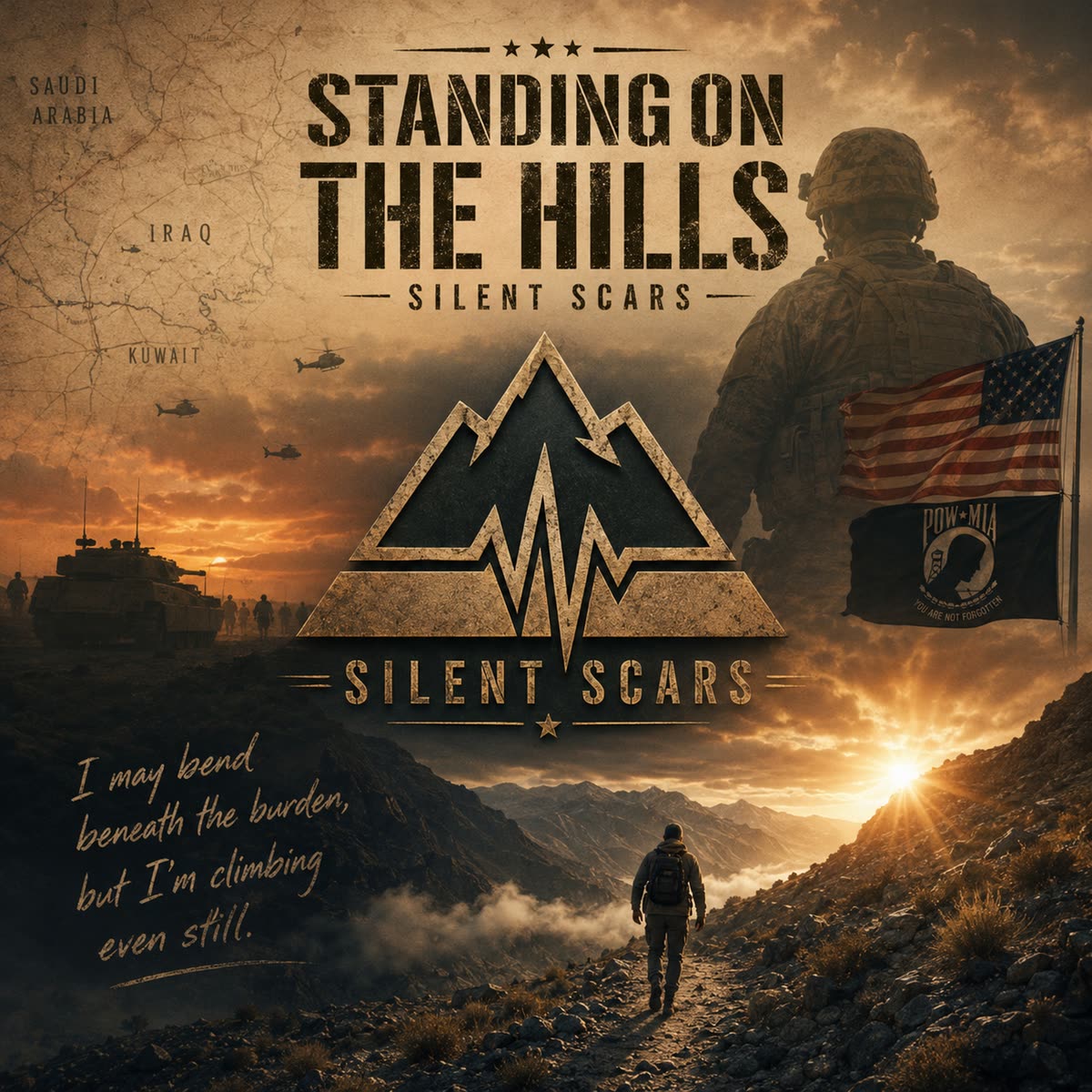
Silent Scars is Rick Camp — direct storytelling and recurring images of deserts, valleys, mountains, sparks, and sunrise, turning private battles into shared songs. It is about what happens after the uniform comes off: invisible wounds, serious illness, broken trust, family, endurance, and the difficult work of becoming whole without pretending the damage never happened — and it is for anyone who knows that road, in or out of uniform. The uniform was the Army’s: a Gulf War reservist called to active duty and sent to Saudi Arabia, Iraq, and Kuwait; the scars began there, and the life afterward shaped the songs. It is not built around medals or easy slogans.
“Still, a stubborn spark kept burning where nobody else could see.”
I'm Rick Camp — Rickey on the legal lines, Rick everywhere else. I carried mine in silence for a long time, like thousands did, before the world learned to call these wounds what they are. These songs are how I seed it forward: something left behind for my family and their generations, and for anyone still down in the valley — veterans especially.
The message is not that pain disappears. It is that pain does not get the final word — and that survival can become a hand extended to somebody still climbing.
And there's more to come. I have a few life stories left in me. Standing on the Hills is just the first one to make it up the mountain.
The house band · no hidden hands
Here's the honest origin story: I wanted to turn my garage into a recording studio. So did Butch Gillespie — my bonus father-in-law, an eighty-year-old Vietnam veteran who lives with my wife and me, and who drummed for a number of country stars back in the day. James on the legal lines, Butch everywhere else — and if the dictionary needed a picture for the word, his would do fine. The studio plan got voted down at home. So my house band became some of the latest in AI music capability instead — it never wakes the neighbors, and it shows up every night.
Silent Scars is me. I write every word — lived first, written second — and the words are registered with the US Copyright Office.
The sound is produced with AI, under my direction. The recordings are made with ElevenLabs Music under a commercial license, from my lyrics, and they are disclosed as AI-made on every platform that carries them. Some tracks and videos feature virtual band members: characters I built to stage the songs. They are cast, not authors.
That's the whole deal: a true story, told with the strongest voice I could give it. Honesty is the first brand rule here, and it applies to the production too. And don't be surprised if Butch makes a few contributions along the way.
New: the making-of, on video. Twenty-Four Receipts to a Single: How I Shipped an AI Virtual Band Without Lying About It — the whole build, receipt by receipt, told on No Doctrine.
Watch the video